The 2026 Belgian Contingent Labour Market: What the Data Tells Us

The message coming out of this mid-year review is clear: the Belgian economy is facing significant headwinds, and the contingent labour market is feeling the impact. At the same time, several structural trends continue to create opportunities for HR service providers that are prepared to adapt. Throughout the discussion, both speakers emphasised that organisations must balance short-term challenges with longer-term transformation efforts if they want to remain relevant in a rapidly evolving labour market.

Published on:

June 4, 2026

Author:

Peter De Buck & Paul Verschueren

The Economic Context: Slow Growth, Rising Uncertainty
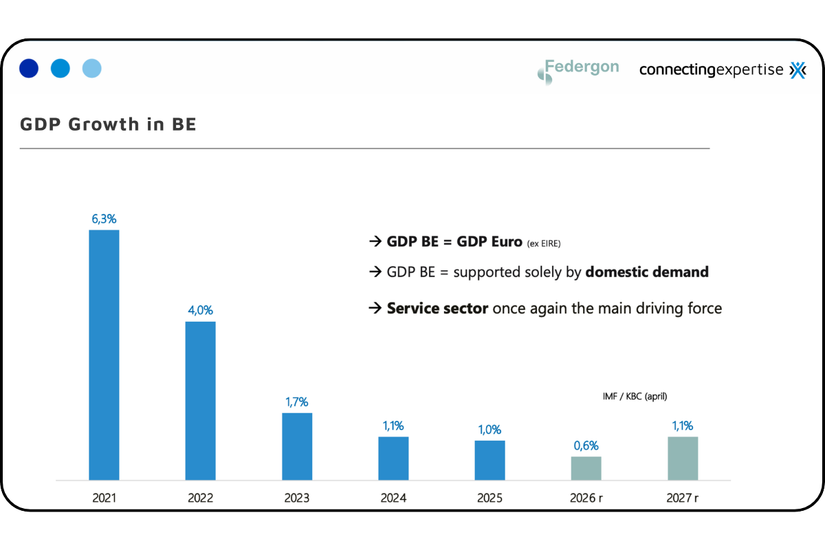
The backdrop to the 2026 labour market story is an economy operating below its potential. Belgium recorded GDP growth of around 1% in 2025, already modest by historical standards. Throughout the first half of 2026, growth expectations have been revised downward. The International Monetary Fund, KBC, the National Bank, and the European Commission now broadly converge on forecasts between 0.6% and 0.7% growth for the year.

One of the main drivers of current uncertainty is geopolitical. The conflict in the Middle East has introduced disruption to global trade flows, supply chains, and commodity pricing. During the webinar, this was highlighted as an important factor behind the deterioration in economic forecasts and confidence indicators. Business confidence has remained below its long-term trend for several years, with industrial activity in particular struggling. Consumer confidence, which had previously supported economic growth, dropped sharply following the outbreak of conflict and has yet to recover fully.

This combination of low growth and inflationary pressure raises concerns about stagflation, a risk that has been highlighted by organisations such as the World Economic Forum. In Belgium, automatic wage indexation adds an additional challenge. While protecting purchasing power, rising wage costs can further impact competitiveness, especially when combined with elevated energy prices and broader cost pressures.
The Labour Market: Strong Employment, Softer Demand

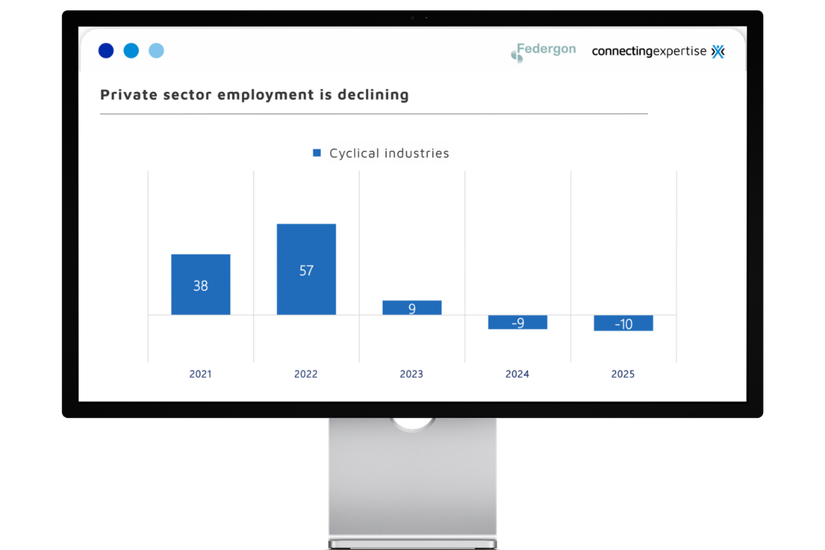
Despite the economic slowdown, Belgium's labour market continues to show resilience. The country has now experienced twelve consecutive years of employment growth, an unprecedented streak. In 2025 alone, approximately 19,000 additional jobs were created, and the National Bank's latest figures indicate that employment growth has continued.

However, this broader picture contrasts sharply with developments in several Federgon-related activities.

Temporary staffing recorded volume growth of just 0.2% in 2025 and moved into decline during the first months of 2026, falling by around 3%. Project sourcing saw volumes decline by 5.8% in 2025, with early 2026 figures showing further contraction. Interim management turnover fell by approximately 12% in 2025. Recruitment and selection experienced a 3.9% turnover decline in 2025, while year-to-date figures for 2026 indicated a significantly steeper drop.

One segment moving in the opposite direction is individual outplacement. Growth in this area appears to be driven primarily by individual layoffs rather than large-scale collective restructurings. Individual outplacement activity increased by 13% in the first quarter of 2026 compared to the same period a year earlier.
The Structural Rise of Contingent Work

One of the most important themes discussed during the webinar was the continuing growth of contingent work as a structural labour market trend rather than a temporary response to economic conditions.

Peter De Buck noted that when Connecting Expertise entered the market 19 years ago, contingent workers represented roughly 10% of the workforce. Based on his observations of the market, that share has grown to approximately 30% today, reflecting a broader shift towards more flexible forms of work.

The National Bank's latest annual report supports the broader trend, particularly regarding self-employment. In 2025, around 19,000 new jobs were created, of which approximately 14,000 were attributable to self-employed workers and around 5,000 to traditional wage earners.

Several factors are driving this evolution. Belgium's ageing population is contributing to growth in independent work among older professionals. Entrepreneurship is becoming increasingly embedded in education and career aspirations. At the same time, worker expectations are changing. Many professionals increasingly value autonomy and want greater control over where, when, and for whom they work. Employers, meanwhile, continue to value the flexibility and specialist expertise that contingent talent can provide.

The Vacancy Rate: Persistent Scarcity Beneath the Surface

Although labour demand has softened, Belgium continues to face structural talent shortages.

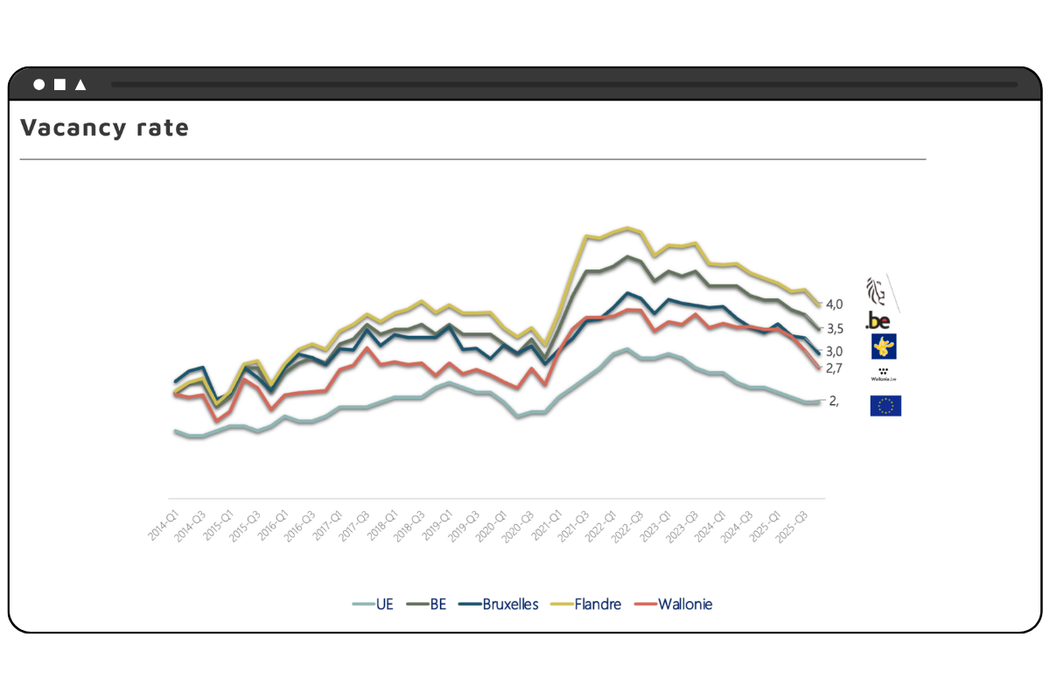
At the end of 2025, Belgium's vacancy rate stood at approximately 3.5%, significantly above the European Union average of around 2%. In Flanders, the vacancy rate reached approximately 4%. Even in regions with lower participation rates, such as Wallonia and Brussels, many vacancies remain difficult to fill.

The situation varies by sector. Construction, community services, hospitality, and IT continue to experience particularly high levels of scarcity. Other sectors, including transport and storage, logistics, finance, and insurance, face somewhat less pressure.

Underlying these shortages is a significant demographic challenge. For every 100 people leaving the Belgian labour market, only around 80 are entering. According to the speakers, this ratio is currently at one of its lowest levels on record and is expected to remain a structural challenge in the years ahead.

The persistence of high vacancy levels alongside slower economic growth illustrates a deeper mismatch in the labour market. While overall demand may be weakening, employers continue to struggle to find the right talent in critical areas. The challenge is therefore not simply the number of available workers, but the alignment between available skills and market needs.

Two developments may influence this dynamic further. First, the government's decision to limit unemployment benefits may encourage greater labour market participation. Second, approximately 70,000 people, around 8% of the workforce, have been absent from the labour market for more than a year.

Reintegration services for this group were highlighted as an important opportunity for labour market service providers. Supporting long-term inactive individuals in returning to work not only addresses a societal challenge but may also become an increasingly important growth area for organisations operating in the HR services ecosystem.

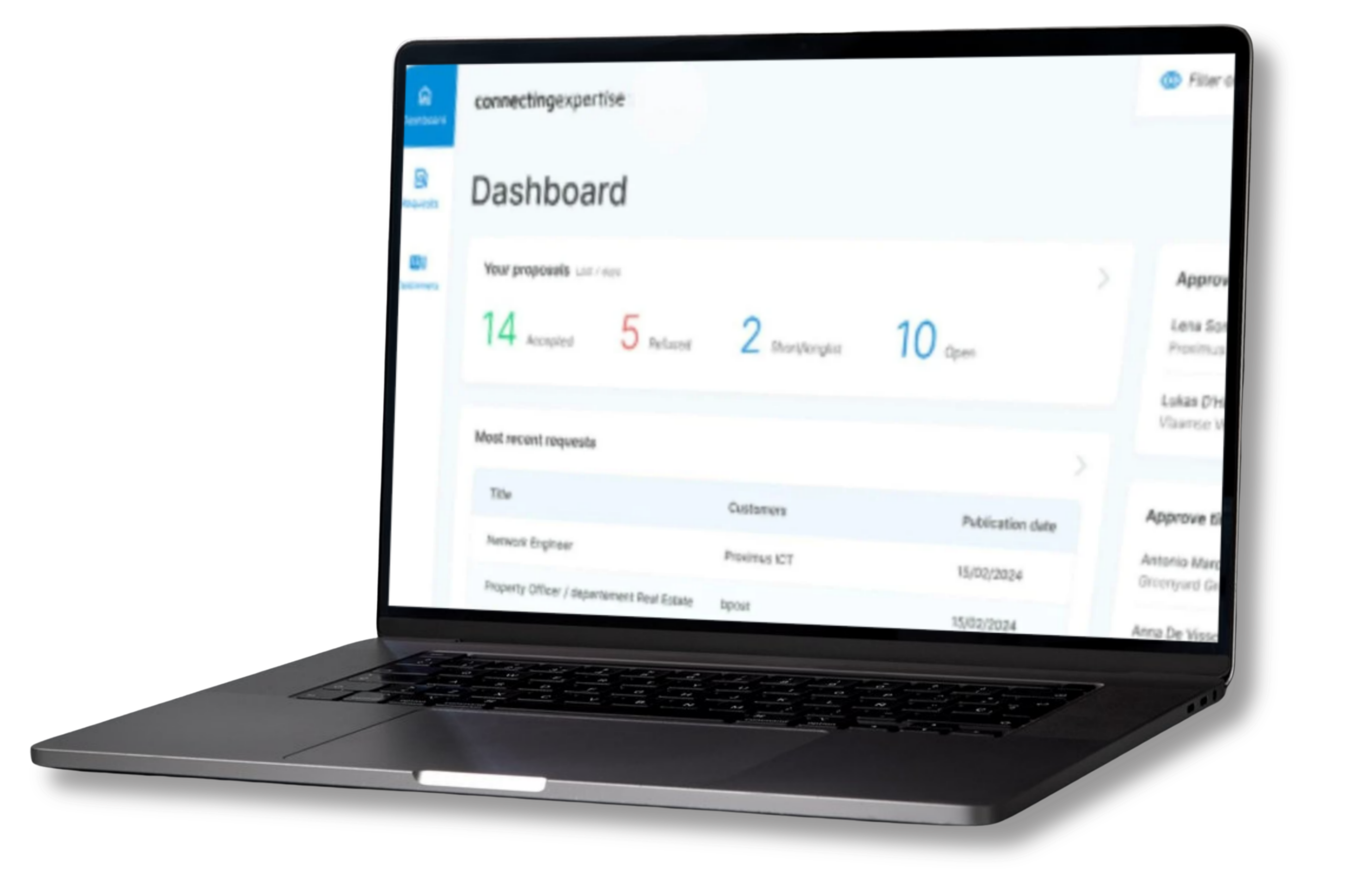
Platform data from Connecting Expertise reinforces the broader market picture. While the customer base continues to grow, the number of vacancy requests is declining. At the same time, the number of candidate profiles submitted is increasing, creating greater competition around a smaller pool of opportunities.

Five Umbrella Trends Reshaping the Industry

Together with Yokodron and Shaping Tomorrow, Federgon conducted a strategic foresight exercise involving industry participants and external stakeholders. The goal was to identify the major forces shaping the future of HR services.

Five key trends emerged.

1. Automation and AI Have Become a Baseline Requirement

Automation and artificial intelligence are no longer differentiators. They are becoming foundational capabilities that organisations must adopt to remain competitive.

Processes such as matching, administration, screening, and planning are increasingly expected to be automated. The question is no longer whether organisations will use AI, but where they will create value beyond it.

A recurring theme throughout the discussion was that AI alone does not create competitive advantage. The real differentiator lies in access to high-quality data and the ability to translate that data into actionable insights. As Peter De Buck noted during the webinar, AI without data is comparable to a car without fuel: the technology itself may be widely available, but the value it creates depends on the quality of the information behind it.

2. Generic Work Is Becoming Increasingly Commoditised

Services that offer limited differentiation face growing margin pressure. As automation becomes more widespread, generic activities become easier to replicate and therefore harder to monetise.

At the same time, demand continues to grow for expertise, specialisation, market knowledge, and advisory capabilities. Organisations that combine labour market expertise with a strong understanding of client needs are likely to create greater value than those relying solely on transactional services.

Criteria Connecting-Expertise SAP Fieldglass Nétive VMS ProUnity
Primary market Belgium / EU Global Benelux / Europe Belgium / Benelux
Founded 2007 1999 2003 2015
Platform type VMS + Marketplace VMS + Marketplace (2023) VMS + ATS + FMS VMS + Marketplace + MSP
Marketplace Integrated supplier and freelancer marketplace, native to platform External Talent Marketplace launched 2023, US-first No native open marketplace Open marketplace with 17,000+ freelancers
Trilingual EN/NL/FR Fully trilingual platform 21 languages globally, not BE-specific Multilingual, Benelux focus French and Dutch content, not fully trilingual platform
Local Belgian compliance Strong, built for Belgian market from day one Via integrations and localisation layers Strong, Benelux compliance focus Strong, Belgian public sector specialist
Configurability High, 8,000+ configuration options High, enterprise-grade, longer implementation cycles High, configurable for mid-market and MSPs Moderate, modular and scalable
Speed to deploy Fast, direct support, short implementation Slower, enterprise cycles, SAP ecosystem dependency Fast for mid-market Fast, marketplace-first model
Freelancer access Yes, direct via marketplace Via External Talent Marketplace Yes, via integrated FMS Yes, core to the platform
MSP support Yes Yes Yes Yes, dedicated MSP team
ISO 27001 Not publicly confirmed Yes Not publicly confirmed Yes, certified March 2025
SAP ecosystem integration External integration possible Native, part of SAP suite Independent Independent
Best fit EU-centric organisations wanting speed, local precision, and an integrated marketplace Large global enterprises standardising on SAP Benelux mid-market and enterprise, MSP programmes Belgian organisations wanting marketplace + MSP + VMS in one

3. Careers Are Becoming More Fluid and Modular

Traditional linear career paths are gradually giving way to more flexible journeys that involve different roles, projects, sectors, and employment arrangements.

This creates demand for guidance, career coaching, workforce transitions, and professional development support. It also allows individuals to build resilience by drawing fulfilment and opportunity from multiple sources throughout their careers.

4. Flexibility Is Being Driven by Both Employers and Workers

Employers increasingly seek workforce agility and the ability to scale capacity up or down according to business needs.

Workers, meanwhile, seek autonomy and flexibility in how they structure their careers and working lives.

Managing the balance between these two forms of flexibility represents both a challenge and an opportunity for HR service providers.

5. The Shift from Matching to Meaning

As matching processes become increasingly automated, value creation is moving towards interpretation, guidance, and advisory support.

Helping organisations and workers navigate complexity, understand labour market developments, and make informed decisions may become more valuable than traditional transactional matching alone.

What This Means in Practice

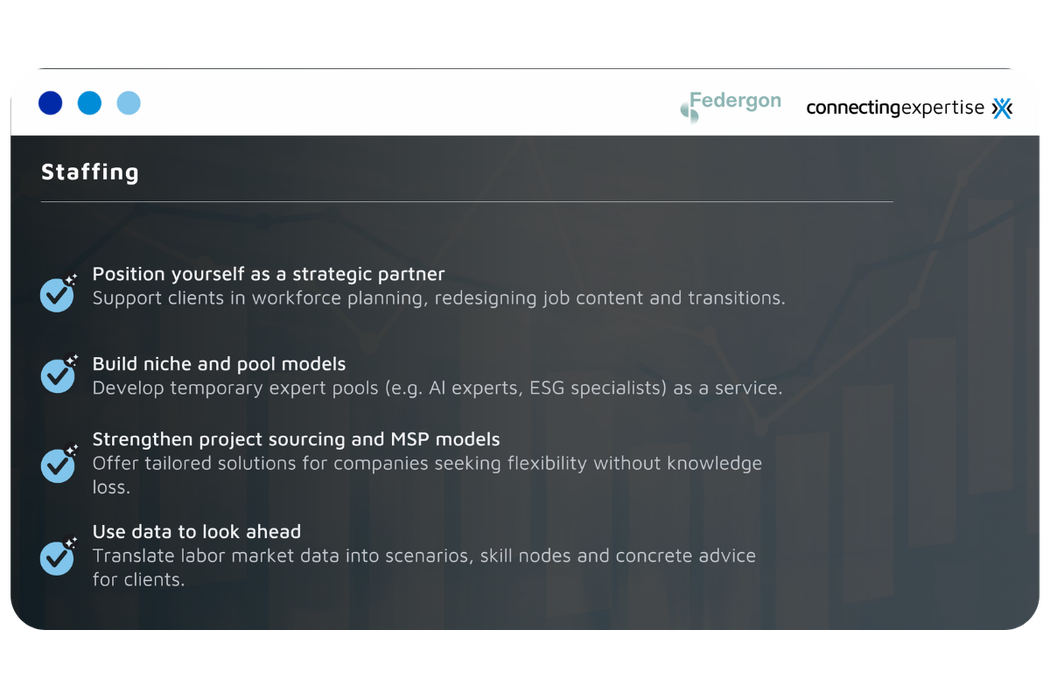
For staffing and project sourcing organisations, the discussion pointed towards a gradual evolution from transactional service delivery towards more advisory-oriented roles. Areas such as workforce planning, labour market intelligence, job design, workforce transitions, and strategic talent planning are likely to become increasingly important.

Building specialist talent communities in areas such as AI, ESG, defence, and cybersecurity was identified as one potential avenue for growth.

Project sourcing and MSP models received particular attention because they combine flexibility for organisations with a degree of stability and security for workers. These models can help organisations access expertise and workforce solutions that they may struggle to organise internally.

Data also emerged as a critical asset. Organisations that can collect, interpret, and translate labour market data into actionable client insights are increasingly positioning themselves differently from traditional suppliers.

For temporary staffing organisations, automation of generic processes is becoming increasingly important. The role of consultants is evolving, requiring different skills and a stronger focus on specialisation and advisory value. Segmentation strategies may also become more important, recognising the differing needs of local workers, international talent, migration profiles, and professionals transitioning between sectors.

Upskilling and reskilling services are likely to play an increasingly important role as labour market shortages persist and employer skill requirements continue to evolve.

The Big Challenge for H2 2026: Managing Today While Preparing for Tomorrow

A central theme throughout the webinar was the need to balance short-term realities with long-term transformation.

Organisations must navigate a challenging economic environment, manage costs carefully, and respond to changing market conditions. At the same time, they cannot afford to postpone investments in automation, data capabilities, new service models, and workforce expertise.

The challenge for the remainder of 2026 is therefore not choosing between operational performance and transformation, but pursuing both simultaneously.

Key Takeaways

The Belgian contingent labour market is operating in a challenging environment, but the webinar's message was far from pessimistic. While several segments are experiencing pressure, structural labour market dynamics continue to create opportunities for organisations that adapt.

Digitalisation and automation are becoming essential capabilities rather than optional investments. AI is increasingly becoming a baseline capability rather than a strategic differentiator. Competitive advantage will come from how organisations combine technology, data, expertise, and human insight to create value for clients and workers alike.

The structural forces shaping the market including demographic pressure, the growth of contingent work, increasing labour market complexity, and the commoditisation of generic services—are unlikely to disappear. Organisations that recognise these trends and evolve their services accordingly will be better positioned to navigate both today's challenges and tomorrow's opportunities.


All figures and insights are based on the mid-year review webinar on the 2026 contingent labour market featuring Paul Verscheueren (Researcher and Regional Director Flanders at Federgon) and Peter De Buck (Partner at Connecting Expertise).

Discover Success Stories

ORES's Advancement in Modernizing Procurement with a Comprehensive VMS Solution
BASF’s Transparent Leap: From Procurement Complexity to Contractor Management Efficiency
By clicking “Accept”, you agree to the storing of cookies on your device to enhance site navigation, analyze site usage, and assist in our marketing efforts. View our Privacy Policy for more information.